HilbertSFC
Ultra-fast 2D & 3D Hilbert space-filling curve encode/decode kernels for Python.
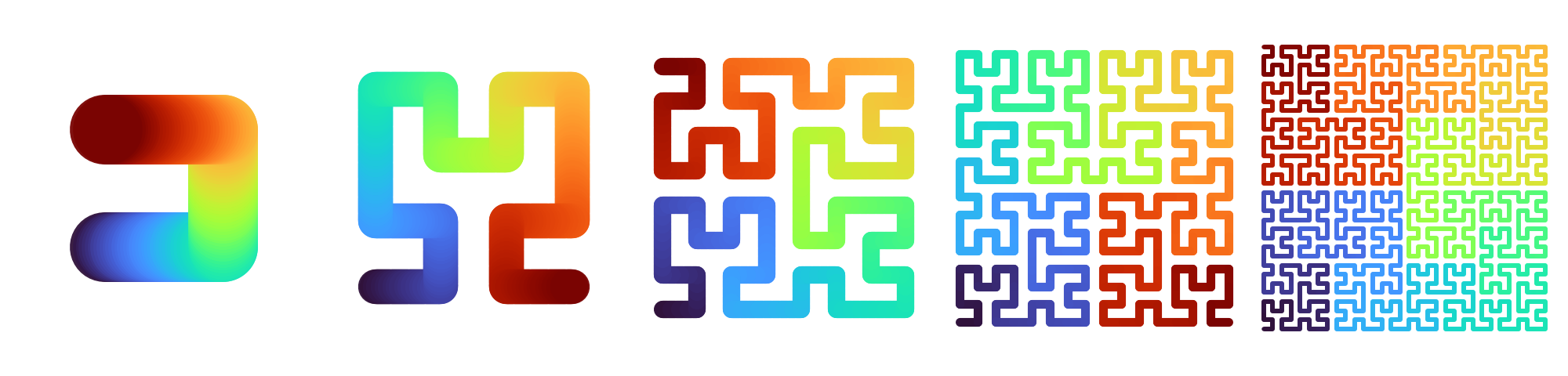
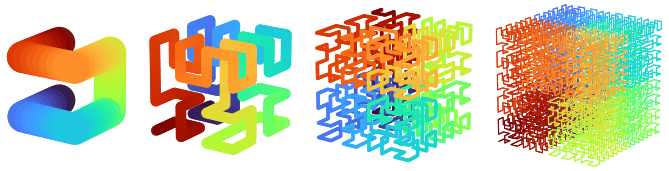
2D Hilbert curves (nbits 1..5) and 3D Hilbert curves (nbits 1..4).
New in v0.3.0: PyTorch API + GPU-accelerated kernels with Triton! New in v0.4.0: Morton/z-order curves
This library is performance-first and implemented entirely in Python. It provides fast Hilbert encode/decode kernels for both CPU and GPU, with convenient high-level APIs for NumPy and PyTorch, low-level kernel accessors, and clean integration with torch.compile for fusion with surrounding operations. For completeness, it also includes Morton/z-order curve kernels.
The hot kernels are JIT-compiled with Numba (CPU) and Triton (GPU) and tuned for:
- Branchless, fully unrolled inner loops
- Small, L1-cache-friendly lookup tables (LUTs)
- Reduced dependency chains for better ILP and MLP (e.g. state-independent lookups)
- Multi-threading for batch processing
- SIMD via LLVM vector intrinsics (CPU)
- Reduced register pressure (GPU)
When and why to use HilbertSFC?
If you have 2D or 3D coordinates and need a 1D ordering that preserves spatial locality, the Hilbert space-filling curve is a strong choice: points that are close in Euclidean space tend to remain close after mapping to a Hilbert index. HilbertSFC is designed for high-throughput workloads, such as spatial indexing (GIS/databases), scientific computing, and machine/deep learning, where Hilbert curve mapping performance matters.